


Open Humanities is the newsletter of Open Humanities Press (OHP), a radical, scholar-led, open access publisher of critical and cultural theory. It explores what it means to create, publish and circulate research and scholarship at a moment marked by the erosion of liberal democracies, the unraveling of the neoliberal world order, the increasing marketisation of knowledge and education, the hollowing out of the humanities, and the growing influence of AI on how information is produced, discovered and shared.
If this newsletter was forwarded to you, you can subscribe here to receive future editions.
Like Open Humanities Press itself, the newsletter is open and free, and will remain so.
Want to continue reading? All previous editions of Open Humanities are available here.
A ‘Who Legislates the Legislators?’ for the 21st Century
Our last Open Humanities newsletter was ‘It’s the End of the World as We Know It: So What Kind of AI Do We Actually Want?’ We ended it by asking:
Could AI bring about the end of capitalism – or at least the lanyard class?
To address this, we looked first at Paul Mason’s argument that AI has the potential to accomplish ‘what Soviet-style planning could never do: replace the market as the rational allocation mechanism’ – potentially destroying the jobs of capitalists, innovators and entrepreneurs in the process.
We then turned to Danielle Abril’s account of how technology companies such as Meta and Amazon are using AI as a justification for ‘cutting away what they call unnecessary management layers and bureaucracy’.
All of which raises an obvious question for higher education: will universities soon start to follow suit? Could AI contribute to a very different economic and social order – and, with it, a very different model of the university – by making managerial and bureaucratic roles within higher education increasingly redundant?
No sooner had we published the newsletter than we came across Aaron Mok’s report on the launch, by AI research startup Sente Labs, of OpenExecutive, a free and open-source AI system explicitly designed to replace CEOs and other senior executives.
‘“Scale your leadership, not your headcount,” its slogan reads. “Our CEO never sleeps” and “never asks for a raise,” a LinkedIn post writes.’
Perhaps the question, then, is not so much whether AI will replace workers, but the far more interesting one: what happens when AI actually comes for the people who thought they were doing the replacing?
AI Resist List
If you like the sound of OpenExecutive, you might also like some of the possible futures identified on the AI Resist List. They include:
Sovereign AI and Sustainable Computation for Indigenous Communities
Two New Books from Open Humanities Press
CONTRADICTionary: An Almanac of Resistance
edited by Bernd Herzogenrath and Nicol A. Barria-Asenjo
https://www.openhumanitiespress.org/books/titles/contradictionary/
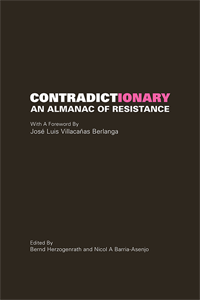
CONTRADICTionary: An Almanac of Resistance is a collective intervention into the politics of language at a time when words themselves are being policed, erased, and weaponized. Emerging from the suppression of terms like ‘diversity,’ ‘intersectionality,’ and ‘climate crisis,’ the project reclaims and expands this contested vocabulary through contributions from over 100 scholars, artists, and activists worldwide. Each entry interrogates how language shapes what can be known, said, and done, while offering new, situated meanings rooted in lived experience and critical inquiry. Neither dictionary nor manifesto alone, CONTRADICTionary operates as a living archive of dissent, embracing contradiction as method and multiplicity as strength. By transforming banned words into sites of analysis, imagination, and action, it challenges regimes of silence and invites readers to actively participate in redefining the terms that govern collective life.
Editor Bios
Nicol A. Barria-Asenjo is a Chilean researcher in Social Sciences and Humanities linked to the University of los Lagos in Chile. Her books include Global Manifestos for the Twenty-First Century: Rethinking Culture, Common Struggles and Future Change (2023), edited by Nicol A. Barria-Asenjo, Brian Willems and Slavoj Žižek; Political Jouissance (2024) edited by Nicol A. Barria-Asenjo and Slavoj Žižek, and José Luis Villacañas in Political Theory (2026).
Bernd Herzogenrath is a professor of American literature and culture at Goethe University of Frankfurt am Main, Germany. He is the author of An American Body|Politic: A Deleuzian Approach (2010), and of many academic essays and articles. He is the editor of various edited essay collections, including The Farthest Place: The Music of John Luther Adams, Deleuze|Guattari & Ecology, and media|matter: the materiality of media, matter as medium. His latest publications include the collections The Films of Bill Morrison: Aesthetics of the Archive (2017), Film as Philosophy (2017), sonic thinking (2017), Practical Aesthetics (2020), Spectral Futures (2026),and the multimedia international arts project (c)ovid’s metamorphoses (meakusma 2023).
Series
CONTRADICTionary: An Almanac of Resistance is published as part of the Seedbooks series, edited by Sigi Jöttkandt and Prudence Gibson.
Afterword to CONTRADICTionary: An Almanac of Resistance
‘Conceptual Battles in the 21st Century: New Paths Towards Other Modalities of the Political’ by Nicol A. Barria-Asenjo & Bernd Herzogenrath
The book that has just concluded is traversed by resistance. The journey from A to W is not innocent: we propose an incomplete alphabet, a deliberately unfinished encyclopedia, which is in itself a political and epistemological argument – the language of resistance is never finished, it never can be.
In this project we have sought to defend the thesis that conceptual resignification is a collective and situated task. No concept has an owner. That is why this book has brought together voices from Latin America, Asia, Africa, North America, and Eastern Europe: different geographies, different experiences, but a shared urgency.
There are themes that cluster and converse with one another throughout these pages: the body and gender (female, trans, transgender, transsexual, sex, sexuality, pronoun, gender-affirming care), race and exclusion (BIPOC, race, racial justice, segregation, indigenous, minority), and threatened democracy (dictatorship, populism, polarization, civil disobedience, protest). That multiple authors orbit the same themes from different disciplines is no coincidence – it reveals where the deepest wounds of the present lie, and the importance of careful reflection on the concept itself, on the power that inhabits it, on the battles waged within it. We have built an encyclopedia that does not claim to exhaust knowledge: an almanac – as the subtitle states – that recognizes that knowledge is seasonal, shifting, situated in time and in the body of the one who writes.
Language is a network, a path, the possibility of constructing the impossible. It is the subjective and the global, the individual and the common. Subversive and revolutionary potential is found essentially in language. At the same time, it is in language that we encounter the void and the ontological impossibility of finding a legitimate place or symbolic inclusion; it is in the territories of language that the subject finds defeat in historical, social, and political terms. A battle that must be restarted, rewritten, and resignified again and again – a circuit and a loop. We are a canvas, we are a script that co-writes the history of the world and the horizon of humanity, and in this we have a task and a responsibility to assume and carry out.
From conceptual renewal, the construction of new concepts, and the necessary resignification of notions that have been repressed, emptied of meaning, or cynically depoliticized for political purposes, we find other existential modalities and other horizons for humanity. We are living in times when agnotology has become an indispensable tool in the face of discursive manipulations that culturally promote ignorance as a political instrument for implementing economic plans and strategies. Hatred and violence have permeated contemporary concepts. Following the COVID-19 pandemic, suspicion, distrust, and proximity became even more common-place; the other, in their existence, embodiment, and becoming, became an agent of chaos. We are immersed in a race to capitalize on emotions, and in this, language has been chosen as a terrain of conquest.
The alteration and manipulation of present-day narratives, the incorporation of new conceptual meanings, the identification of certain concepts as enemies, and the extreme political measures of prohibiting certain terms in official documents, allow us to see the desperate attempt to impose absolute numbness and inertia on societies. Defending our language, our discourses, our meanings and significations, establishing and sharing our senses, has never been so urgent or so necessary.
In our time there have been systematic attempts to eliminate the political element from language, to produce conceptual mixtures that have left the concepts themselves in an abstraction in which the political attempts to reveal itself and survive. Under the arrival and attempted domination of the concept of “depoliticization,” the political has sought to be eradicated from the territory of global politics, profoundly affecting contemporary civilizations. Truth lies at the heart of contemporary politics, which seeks to be conveniently altered and transformed according to capitalist logic and interests. Never before has it been so necessary to undertake the task and assume the responsibility of drawing new conceptual maps and fostering conceptual renewal.
Politics has never abandoned language. Words are not empty. Discourses are sites of struggle and transformation. This is one of the central ideas pursued in this project: to create a counter-dictionary that manages to map out the concepts that must be contested and resignified. Words are always imbued with senses, symbolism, meanings, and significations that shape the subjective constitution of the individual. In this book we have worked with the concept, with concepts; it is not a dictionary that addresses all essential terms, but rather only those that the authors – in accordance with their particular experiences, their biographical development, their political orientation, their nationality, and their discipline – have identified as urgent, as wounded, as in need of new life. This book is itself a conceptual battle that produces new meanings carved from the search for new modalities of the political.
This book addresses sensitive issues, essential human themes that have remained as traces on the paper of public policies, with ephemeral practical progress, swept essentially under the rug by the passage of history and the priorities that year after year increase and strengthen, always oriented toward the economic, forgetting the human and humanity. It is a structure with political pillars that constitutes an immense range of emancipatory horizons and reinventions of the human – a sustained wager on the possibility that words can transform the world, or at least prepare the ground for those who will.
In times when banning words has become state policy, publishing a book like this is also an act of civil disobedience. Every concept worked through here is a trench. Every author, a custodian of meanings that power would prefer to erase, silence, or hollow out. Against administered silence, we oppose the fertile noise of resignification.
This book does not end here. It ends in the reader, in whoever takes a word and returns it to the world with different weight, different intention, different life. The CONTRADICTionary is, ultimately, a threshold: what comes next depends on the hands, the voices, and the struggles of those who continue this task. We are what we name – a writing, a text, a scriptural DNA (Barria-Asenjo, 2026). And in what we refuse to stop naming lies also what we refuse to stop being. The language of resistance, like all true resistance, does not conclude. It reinvents itself. This almanac is, first and foremost, a wager on humanity – imperfect, unfinished, but irreducibly
alive in its words.
The whole of CONTRADICTionary: An Almanac of Resistance is available here.
Transit Asia Critical Concepts
edited by Joyce C. H. Liu, Brett Neilson, Karin Oen-Lee and Ned Rossiter
https://www.openhumanitiespress.org/books/titles/transit-asia/
Concepts hold the world together. But what happens when the world fragments, explodes in war, faces the epistemic collapse wrought by AI, or the ravages of climate spun out of control? Concepts also disintegrate, lose their self-positing status. And yet critique does not simply dissolve in conditions of radical uncertainty. There is a hunger to critique. It finds new forms, partial, provisional, forged from within instability rather than above. Transit Asia Critical Concepts emerges from this conceptual turbulence.
The concepts gathered in this book are not designed to map Asia, to fix its contours, or confirm its coherence. They move across Asian environments, through infrastructures of labour and logistics, inside computational architectures and their human remainders, against the unevenly distributed catastrophes of climate and war in ways that exceed the regional frame they inhabit. That excess is not incidental. It is what thinking from Asia produces, a movement beyond the cultural imaginaries, institutional settings, and lived encounters that give Asia its apparent shape.
Editor Bios
Joyce C. H. Liu is Professor Emerita and Director of the International Center for Cultural Studies, National Yang Ming Chiao Tung University, Taiwan. Her work on coloniality, biopolitics, and Inter-Asian infrastructures includes One Divides into Two (2020) and Tianxia and Its Discontents (Routledge, 2026).
Brett Neilson is Professor at the Institute for Culture and Society, Western Sydney University. He is author, with Sandro Mezzadra, of Border as Method, or, the Multiplication of Labor and The Politics of Operations: Excavating Contemporary Capitalism.
Karin Oen-Lee is Assistant Professor of Art History and Museum Studies at the University of Maryland, Baltimore County. Her work as a curator, editor, and art historian focuses on diasporic, transdisciplinary, and interlocal creative practices as part of global Asia.
Ned Rossiter is Director of Research at the Institute for Culture and Society, and Professor of Communication, School of Arts, Western Sydney University. His current book projects include The Logistical Episteme and (with Soenke Zehle) Entropological Materialism: Ordering Disorder in the Cybnernetic Century (2027).
Series
Transit Asia Critical Concepts is published as part of the Low Latencies series, edited by Brett Neilson and Ned Rossiter.
From the Introduction to Transit Asia Critical Concepts
‘TRANSIT ASIA AS CONCEPT’
Concepts hold the world together. But what happens when the world fragments, explodes in war, faces the epistemic collapse wrought by AI, or the ravages of climate spun out of control? Concepts also disintegrate, lose their self-positing status, their claim to stand above the flux they describe. Maybe this claim to self-grounding was always an ontological fantasy anyway, a conceit of the Enlightenment, of the West. In Chinese thought from the Song dynasty, concepts are tied to the propensity of the times (shishi). They come and go. It is not, as Gilles Deleuze said, that concepts are like bricks that can build a courthouse or shatter a window. Rather, concepts themselves shatter with the times. They can self-dissolve as readily as they create and destroy. At the very moment of grasping the world, they may be losing their grip on it. Abstract units may furnish space as actionable, but their purchase on the world, and on its histories, is never guaranteed. For all the urgency they command within the academy, the legacies of colonial occupation and imperial endeavour resist easy measure within temporal horizons of human continuity and organic contortions that span millennia. Longevity, where it occurs, demands a reckoning.
A dominant tendency within Sino-civilizational narratives upholds the worldview of tian ming (Mandate from Heaven) as a foundational concept to account for over 3,000 years of imperial rule. The persistence of tian ming owes not to any escape from history, but to the concept’s repeated availability to the occasions in which it was required. Tian ming is always shadowed by its corollary of rebellion. Historical continuities are riven with ruptures and rivalries, disputes and disturbances. Concepts find potency as political expression; they drift as aesthetic reverie or burst as spectacular eruptions into the placid surface of routine. In the end, duration is not transcendence, and recurrence is not providence. Persistence goes on until it terminates. What seems like permanence is just the longer arc of contingency. Concept production can flourish and exceed expected constraints while remaining circumstantial to the moment of its unfolding. In other words, concepts are neither here to stay nor assumed as given, and it is precisely this provisionality that makes them worth making. Concepts speak to the conjuncture. Transit Asia is no exception, at once historical and contemporary, anchored and adrift, formal and experimental. As a proliferation of ideas and expressions bound in this instance as a book, Transit Asia institutes….
Transit Asia Critical Concepts continues here.
Barbarian Currents: London Talk, Screening and Book Review
‘Other Art Histories’
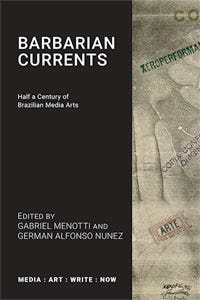
The Centre for the Ecologies of Attention and Perception at King’s College London hosted a talk, accompanied by a screening, on reframing the history of art history. What is it like to look at art history sideways, from the perspective of niche practices undertaken in marginalised territories?
In their presentation, chaired and introduced by Joanna Zylinska, Gabriel Menotti and German Nunez discussed possibilities of reframing the discipline and its established categories from the Global South, based on their experience of editing the pioneering anthology, Barbarian Currents: Half a Century of Brazilian Media Arts (Open Humanities Press, 2025, open access).
Barbarian Currents gathers more than fifty original texts from Brazilian authors, artists, critics and curators – most of them published in English for the first time. The book advances a compelling sociological approach to the development of arts and technology in Latin America and, arguably, the world.
Menotti and Nunez accompanied their talk at King’s with a screening of historical Brazilian video art.
Speaker Bios
Gabriel Menotti is a Brazilian independent curator and filmmaker working across various media. He works as Associate Professor and Director of Curatorial Studies at Queen’s University, Ontario, Canada. He has published extensively on the subject of images, institutions and technology. His works have been shown at various institutions worldwide, such as the São Paulo Biennial, Centre Pompidou and the transmediale festival. His latest publications are the monograph O filme em circuito (Editora Machado, 2026) and the Barbarian Currents anthology. Menotti is also one of the coordinators of the Besides the Screen research network and festival.
German Alfonso Nunez is a social art historian whose research examines the intersections of contemporary art, social history, technology and visual culture, with a particular focus on Brazil. He received his PhD from the University of the Arts London and has held postdoctoral fellowships at the University of Campinas (Unicamp), the University of São Paulo (USP) and Stanford University. He is the co-editor of Barbarian Currents and the editor of the publication marking the 75th anniversary of the Museum of Modern Art of São Paulo. Since May 2026, he has been Assistant Professor at the Museum of Contemporary Art, University of São Paulo.
Barbarian Currents is published as part of the MEDIA : ART : WRITE : NOW series, edited by Joanna Zylinska.
From the Introduction to Barbarian Currents
‘Technicised Barbarians’ by Gabriel Menotti and German Alfonso Nunez
Though familiar to many Brazilian art enthusiasts, this story remains relatively unknown outside of those Portuguese-speaking circles. it is about a strange artwork that unsettled the jury, critics and audiences of the very first São Paulo Art Biennial in 1951. At a distance, the piece looked very much like an abstract painting: multi-coloured blots on a canvas, stretched over a rectangular wooden frame and hanging from a wall. the blots, however, shifted. They moved and constantly changed over time, unlike anything that the public had ever seen before: an animated painting! A newspaper review called it ‘magical’ for the way it dazzled viewers with a ‘parade of colours and shapes’ (Tribunada Imprensa 1951, 5). Magical indeed: these visual transformations were the main thing that caught people’s attention. But hidden under the surface of the canvas was something equally impressive: a bespoke mechanism made with electric motors, gears, rods and lightbulbs. not unlike the budding medium of television, the work presented viewers with a surface of live information. And, similar to TV, it did not function if it was not plugged in.
Was it a painting, a sculpture or something completely new? The artwork was initially rejected because the selection committee could not place it within any of the exhibition’s categories. But it made such a strong impression that the Biennial jury decided to award it a special mention anyway. Perhaps it was a bittersweet prize for something so unique. Still, not a bad result for a piece that was admitted to the exhibition at the very last minute – and only because of some logistical missteps: it was there to replace Japanese artworks that did not arrive in São Paulo on time.
Titled Azul e Roxo em Primeiro Movimento [Blue and Purple in first Movement] (1951), the piece is one of the very first cinecromáticos conceived by a then young Abraham Palatnik (natal, 1928-2020). In hindsight, it could be considered a textbook case of kinetic art, a visual arts genre that deploys movement as a central component of its poetic vocabulary. But within the Brazilian cultural context of the time, Azul e Roxo… meant much more. in its use of electricity and automation, it seemed to anticipate a post-war trend that had artists all over the West turn their attention to new media and technology.
The following decade would see the emergence of Fluxus, an international movement that brought process, performance and electronic systems to the forefront of art practices (Higgins 2002). In 1965, the first gallery exhibitions of computer graphics took place in the USA and Germany (taylor 2014). A year later, engineers Billy Klüver and Fred Waldhauer would partner with artists Robert Rauschenberg and Robert Whitman to form the non-profit Experiments in Art and Technology, in an attempt to promote collaborations across those areas (Klüver 1994). In that same year, John Whitney Sr., a pioneer in mechanical animation techniques, was awarded an artist-in-residence position at IBM, which led to the development of digital motion graphics (Kane 2014).
Eventually, a number of those new technological expressions were canonised under the umbrella of the late avant-gardes. yet others were not. The creation of the British Computer arts society, already in 1968, testifies to the fact that some art forms emerging in that era were not fully accepted by the contemporary arts establishment….
Barbarian Currents continues here.
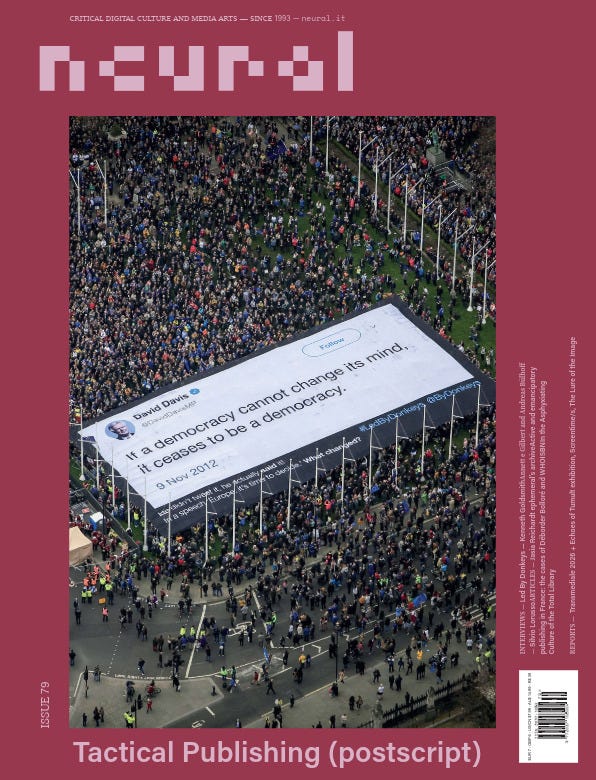
The latest issue of Neural magazine also features a review of Barbarian Currents.
Thank you for reading!
Please feel free to share this newsletter with anyone you think might find it interesting.
Say hi or leave a comment.
We welcome the submission of ideas and material for future posts. This includes suggestions for different ways of using Substack that are consistent with the values and practices of OHP, rather than Open Humanities being just another newsletter.