
Open Humanities is the newsletter of Open Humanities Press (OHP), a radical, scholar-led, open access publisher of critical and cultural theory. It explores what it means to create, publish and circulate research and scholarship at a moment marked by the erosion of liberal democracies, the unraveling of the neoliberal world order, the increasing marketisation of knowledge and education, the hollowing out of the humanities, and the growing influence of AI on how information is produced, discovered and shared.
Like Open Humanities Press itself, the newsletter is open and free, and will remain so.
From Search to Chat
We’ve been asked to expand on a remark in our first Open Humanities newsletter, where we referred to:
the predicted shift away from material, including open access publications, being discovered through search engines such as Google and DuckDuckGo, and toward knowledge and information being accessed through AI chatbots instead. (Apparently, much of Gen Z has already begun to make the switch.)
Why does this shift matter?
For the last twenty years, much of the open access movement has assumed that, if research is made freely available online, those with access to the internet will be able to find it. Search has been one of the principle infrastructures linking openness to discoverability.
But that infrastructure is changing.
Instead of typing keywords into a search engine and scanning the results, people – especially younger users – are increasingly entering into dialogue with ChatGPT, Claude, Gemini and other large language model (LLM) AI systems: asking questions, providing prompts and receiving support with decision making in return. A 2026 Pew Research Centre report, for instance, has found that more than half of US teenagers now use AI chatbots to search for information.

If this trend continues, AI ‘assistants’ may soon become the primary interface through which research and scholarship is encountered, by undergraduate and postgraduate students particularly.
At the moment most of these systems operate according to a familiar freemium model. Here, basic access is free, while more advanced ‘premium’ features require payment, usually through a monthly or yearly subscription (as recently introduced by ByteDance, owner of China’s most popular chatbot Doubao, as well as TikTok).
We’ve seen this pattern before. Many of today’s platform capitalist businesses initially offered free services for a few years, regarding this as a means to become larger than their competitors as quickly as possible in order to benefit:
firstly, from the network effect, whereby everyone uses them, be it Facebook, Academia.edu or LinkedIn, because everyone else does;
secondly, from the advantages of scale: the larger the dataset they accumulate, the greater amount of material they can process, mine and analyse. This allows these Big Tech businesses to extract more precise insights than those of their competitors with smaller data pools.
Eventually, however, they needed to make a profit. They sought to do so not only by introducing subscription fees for premium features, but also by surveilling users’ behaviour on their platforms and monetising the resulting data through advertising and sponsored search results.
It’s therefore no surprise that Big AI companies are beginning to go down the same route, with some introducing the targeted advertising model of extractivist social media platforms into their chatbots, including the once non-profit OpenAI’s Free and Go subscription tiers for ChatGPT. After all, these AI systems already have access to everything users share with them. Given both the scale of their adoption – by May 2025 ChatGPT had become the fifth most visited website in the world – and the intimate nature of many of these exchanges, with people increasingly treating them as career coaches, therapists, mentors, friends, even surrogate romantic partners, it was perhaps only a matter of time before users’ prompts and interactions came to be routinely surveilled, and the resulting data likewise became monetised through paid adverts or charges for ad-free versions.

Some have even argued that, in the future, it will not simply be more and more of our interactions that are monetised in this way – particularly as AI becomes embedded in wearable devices such as Ray-Ban Meta AI glasses – but our intentions. These companies will use GenAI to understand what we want before we know we want it, and then draw on this intimate knowledge to present it in ways that are designed to influence, persuade and ultimately manipulate us into consuming it.
As we said in our first Open Humanities newsletter, this AI ecosystem is already narrower than the open web, being shaped by the datasets these companies have been able to assemble to train or fine-tune their models, often without authorisation or licence. If we want our open access publications to appear in responses generated by today’s chatbots, we must therefore hope they are included in these datasets, regardless of whether that material was acquired by scraping websites, downloading content from ‘pirate’ libraries, or other means. Even then it may not be enough, given that xAI’s Grok has been explicitly designed as an ‘anti-woke’ counterpart to OpenAI’s ‘politically correct’ ChatGPT, according to Elon Musk. Making research freely available online thus no longer necessarily means it can be easily found (and this in spite of the best efforts of dedicated academic discovery services such as the Directory of Open Access Journals and Directory of Open Access Books).
Moreover, if things keep heading in this direction, there’s a danger of this ecosystem narrowing still further through the introduction of pay-to-play models where, if you don’t pay the likes of Anthropic and Microsoft, their chatbots will be less likely to mention your research in responses to users’ queries and prompts. If that happens, and visibility within AI-generated responses becomes, at least in part, something that has to be purchased, open access communities such as Open Humanities Press will face an even greater challenge.
Go Analogue
What other forms of intellectual communication are possible when search is replaced by chat as the primary means through which knowledge and information are discovered online?
One response is to secede from the digital ecosystem altogether.
Many artists, activists and community organisers have begun returning to low-tech, analogue forms of communication. The resurgence of artist books, paper zines, pamphlets and DIY print media speaks to a collective desire to escape the constant tracking, scraping and training of the public online world. These formats make it possible to share vital knowledge – about Gaza, abortion access, queer rights, trans health practices – and to build community beyond the purview of corporate algorithmic monitoring, filtering, data profiling and state control.

As Mariame Kaba, founding organizer of the Black Zine Fair, observes, more and more people feel they ‘can’t say certain things’ online. In this context, zines offer a means to ‘share personal experiences, to make connections with other people, to fight censorship, to evade the surveillance that’s consistent and constant when you are on digital platforms.’
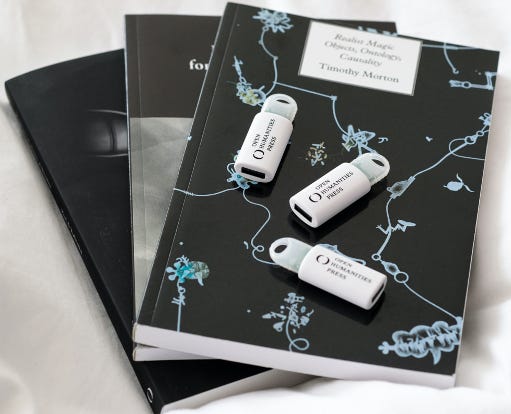
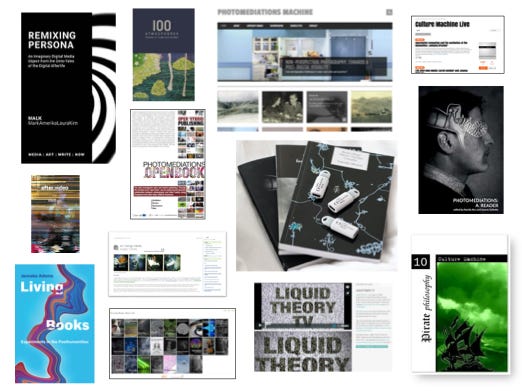
There is much to admire in this approach. We’re certainly not against occasionally making work available in analogue or offline-only form, should the situation call for it (as the first image in this edition of the newletter indicates). Yet for an open access publisher such as Open Humanities Press, whose main purpose is to make critical and cultural theory freely available online, abandoning the digital realm altogether hardly seems the most appropriate response.
Build Direct Relationships With Readers
A second answer to the question (also pointed to in our first newsletter) is one that many legacy publishers – newspapers, magazines, book presses – are currently pursuing. They, too, are concerned that readers may soon no longer discover their publications by searching online. Accordingly, they are attempting to bypass the Big AI middlemen by cultivating relationships with audiences they can communicate with directly using subscriptions (whether paid or free) to newsletters, podcasts, book clubs, YouTube channels and short-form videos.
This explains why there suddenly seem to be newsletters everywhere!
Already, traditional media companies and online publishers are no longer attracting the audiences they once did. It’s a situation that has been exacerbated by Meta’s decision to change the algorithms behind Facebook and Instagram from 2024 onwards to prioritise creator content over links to publishers. As a result many are shifting towards subscription-based models that seek to establish a more direct relationship with readers and viewers. A lot of journalists at mainstream news outlets, for instance, are now being pushed to embrace short-form video and operate much more like YouTube and TikTok talking-head, camera-facing content creators in order to reach larger audiences. (The algorithms tend to reward videos in which people feature their faces. Hence podcasts are also now filmed and then clipped up into short videos in the hope they’ll go viral.)

Yet this strategy carries its own risks. Even among those who want to create media according to a different set of principles from the mainstream, including a privileging of – and search for – connectivity, cooperation, collaboration and community through mailing lists, message boards, Discord channels and indie presses, the gravitational pull of the algorithms remains strong. All too often they end up reproducing the neoliberal subjectivity of the commodified ‘authentic’ self and cult of personality associated with the attention systems of late capitalist influencer culture; and do so even as they’re mocking, critiquing and misusing this hyper-individualistic subjectivity and trying to move beyond it.
This approach to the problem also demands a relentless cycle of posting, responding and promoting to stay current, feed the algorithms and pursue virality and reach (and in many cases income, too, through subscriptions, micro-payments and the sale of merchandise). It’s a cycle that, as well as explicitly and implicitly shaping work (social media is not a neutral tool, after all), can quickly lead to exhaustion, anxiety and burnout - not to mention overwhelming narcissism.
Create Smaller-Scale Communities
A number of factors have been paving the way for the emergence of a third response to the dilemma. They include the way:
younger Gen Z internet users are moving away from platforms full of ads and AI slop towards online discussion forums such as Reddit, which they regard as being populated by more authentic posts from actual humans. (As of 2026, Reddit has overtaken TikTok as Britain’s fourth most visited social media service. It is ‘now the sixth most visited organisation of any kind by UK users aged between 18 and 24, up from 10th a year earlier. More than three-quarters of that cohort now visit it.’ A recent agreement with Google enabling the company to use Reddit to train its AI models also seems to have increased its visibility. Reddit is now the most cited source in Google’s AI Overviews, a development likely to drive more traffic to its forums. Reddit has entered into a comparable arrangement with OpenAI.)
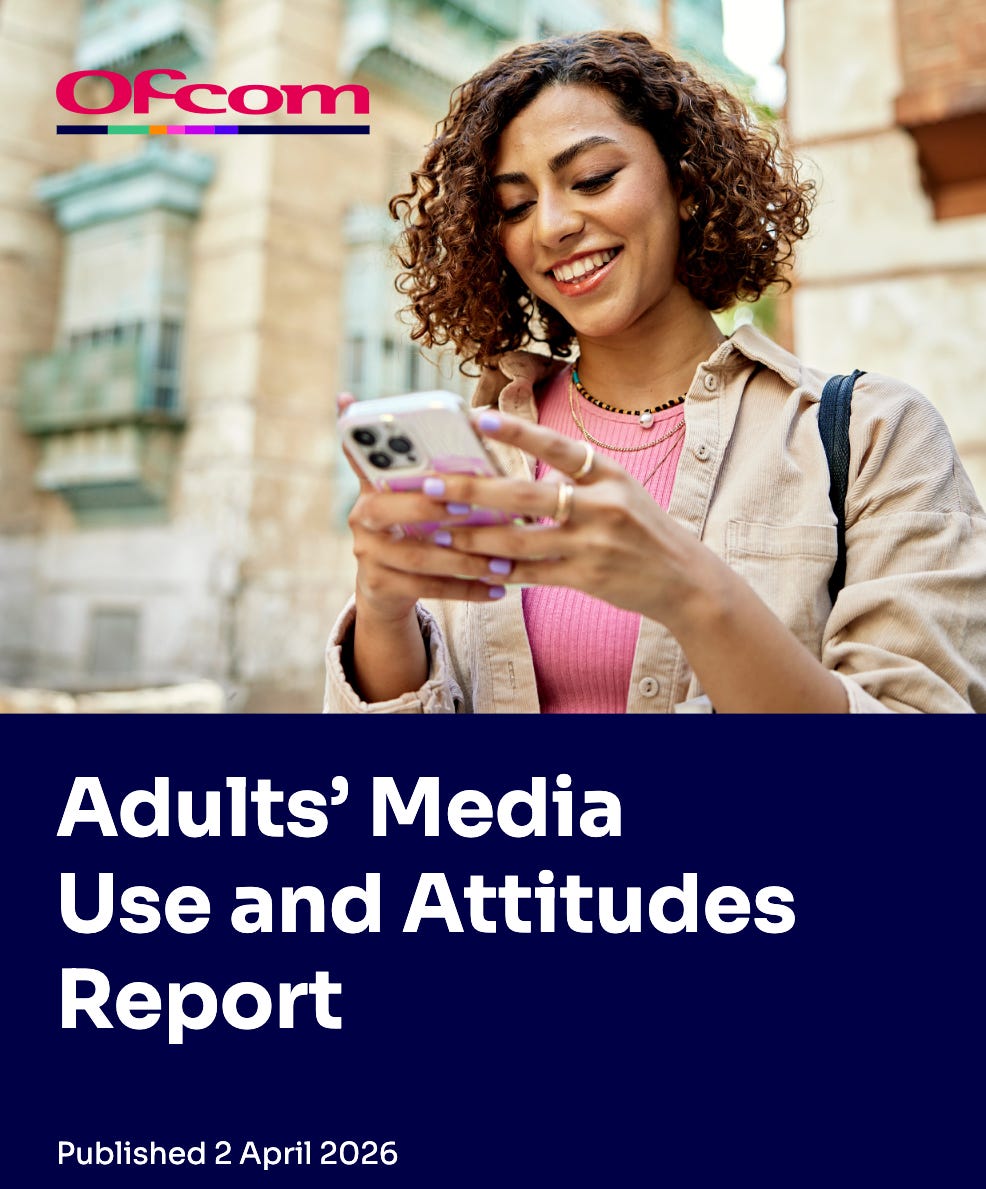
people are generally contributing less to algorithmically mediated broadcast platforms like X, Instagram and Facebook, with Ofcom reporting that the proportion of adult social media users in the UK who post, share or comment has dropped by 12 percentage points in the last year alone.
These platforms are increasingly seen as angry, unsafe and often cruel environments where users cannot fully be themselves yet are still expected to perform in public and live with the consequences. Consequently, many are turning to private or semi-private environments such as WhatsApp and Signal. These are regarded as relatively safe spaces where users can be themselves: trusted networks in which they do not necessarily want to be seen or noticed by large numbers of others, but do want to share ideas that matter to them and their specific communities. (This also helps explain why there is reportedly less interaction on public-facing social media platforms nowadays: more people lurking or passively consuming TikTok videos and Instagram Reels as entertainment rather than actively engaging in posting, sharing or commenting as they might once have done on Twitter or Facebook);

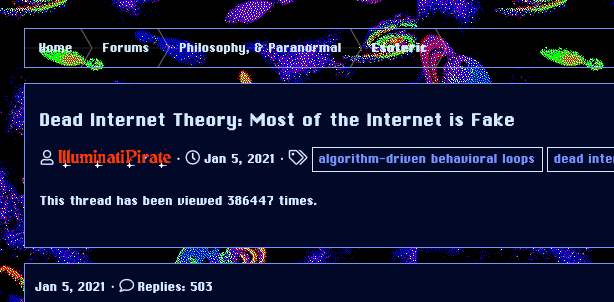
having a large social media following is being taken more and more as an indication that your work has become overly shaped by the algorithms. Post-pandemic, after a period of everyone being perpetually online, accumulating thousands of followers is no longer particularly difficult or unusual. With ongoing talk of a ‘dead internet’, where content is ever more AI-generated and followers may be bots, it may even be read as a warning sign. Having fewer than 500 followers, by contrast, can suggest that, if you’re posting at all rather than ‘posting zero’, you’re posting about what genuinely interests you, not what the internet wants you to find interesting.
This has led other thinkers to embark on what they’re terming a ‘post-naïve era’. Here, rather than struggling for idealistic ‘grand alternatives like the free and open internet for everyone’, and if that fails abandoning the internet altogether, they are being more ‘realistic’ in building digital infrastructure that is designed to meet only their own specific needs and core values along with those of their communities.
They are spending less time and energy attempting to broadcast to everyone on infinite scrolling public broadcast platforms such as X, Instagram and TikTok, and more time participating in smaller communities: groupchats, newsletters, book clubs, private forums and other trusted networks. In short, they’re retreating into ‘the dark forest of the internet’ by moving away from ideas of universal visibility towards more situated groupings where they can quietly come together to create their own online spaces or miniverses.
An Experiment
In this sense the Open Humanities newsletter is itself an experiment. One of the questions we’re exploring with it is: Where does Open Humanities Press and its network of interlacing scholarly communities fit into all this?
Should we simply keep calm and carry on much as before, even as people gradually shift from search to chat – and, if it comes to it, pay AI platforms for visibility?
Should we try to get ahead of the game by cultivating direct relationships with readers through newsletters, podcasts, book clubs, YouTube channels and short-form videos, with all the attendant risks this strategy involves?
Or should we begin to imagine something else: a community of smaller, situated scholarly communities perhaps, one that remains responsibly open while no longer necessarily aspiring to universal visibility?
We don’t yet have an answer.
Perhaps the point of the Open Humanities newsletter is not to provide one, but to create a space in which we can begin working it out together.
Thanks for reading!
Please share with anyone you think might find it interesting.
Say hi or leave a comment.
We welcome the submission of ideas and material for future posts. This includes suggestions for different ways of using Substack that are consistent with the values and practices of OHP, rather than Open Humanities being just another newsletter.
Thanks Simon. I very agree with you on the problem of labour and finance, as made clear by my response to both yourself and Stevphen Shukaitis on the Radical Open Access list yesterday. I'll repost it here, save anyone reading this having to go in search of it.
---
Thanks Stevphen and Simon for such thoughtful and generous responses. I guess with that newsletter we were trying to get ahead of things when it comes to thinking through the implications of the shift from search engines to AI chatbots, rather than just letting things happen to us. But the question of what kinds of intellectual and social relationships we want publishing to make possible is also a good starting point for thinking further about all this.
Speaking of social and human costs, I do worry about how much longer there will be enough people around who are willing and able to have such encounters, sustain such social relationships, participate in such communities of study and collective intellectual production, and bring new projects into being. As we know, large numbers of scholars are leaving the mainstream university system as a result of 'restructuring' (for which we can read the 'hollowing out' of critical subjects such as the humanities and social sciences). In the UK, 'nearly 4,000 academic posts in social sciences, humanities and the arts have been axed in one year alone. In the 12 months to December 2024, just under 3,000 social sciences, 820 humanities and 240 arts jobs went. All but 110 were in non-Russell Group universities, reducing student choice and potentially exacerbating inequalities' (https://www.theguardian.com/education/2026/jul/14/university-job-cuts-humanities-social-sciences). The number of early-career humanities staff has fallen by 20% over the last decade (https://www.timeshighereducation.com/news/humanities-hardest-hit-early-career-opportunities-disappear).
As a result, many early-career scholars are choosing not to remain in - or even to enter - the university system as researchers or lecturers: because they're seeing it as unattractive, precarious, individualised, conservative, hypercompetitive - in short, toxic.
Of those who do remain in the university, many are overworked - not least because they're having to take on the work of colleagues they've lost. They simply don't have the 'time, spaces or capacities' to devote to such communities: to 'editing, organising, facilitating, maintaining relationships, caring for spaces' and so on.
Because of the pressures of academic employment, promotion and evaluation, other early-career scholars apparently feel they have to echo what those in older generations who have achieved high-status do and say. They almost deliberately bland themselves out (consciously or unconsciously), continuing to operate much as such legacy academics did. So, yes, as Simon says, many are concerned with getting 'a standard article out so that they can obtain a job or advance their career', rather than with who is producing knowledge, experimenting with infrastructure and the 'social infrastructures of publishing', or setting up their own publishing projects.
(Speaking of bringing new projects into being and encouraging a proliferation of experiments: to what extent are early-career scholars starting new open access academic presses these days, does anyone know? Or is this an activity that pretty much belongs to previous generations, with scholars today more likely to be interested in publishing on Instagram, Tumblr and YouTube and forming communities by running book clubs and hosting in-person events? After all, both Open Humanities Press and Minor Compositions are nearly 20 years old now, having been launched within a year of each other. Was there something in the air in 2008/2009 that isn't in the air so much now?)
As a result of all this, there's a real process of re-centering underway, one that goes beyond 'the infrastructures of academic publishing [becoming] increasingly concentrated in the hands of commercial interests', as Stevphen puts it, and that's moving in the opposite direction to which Ngũgĩ wa Thiong’o (an original board member of OHP) directs us in Moving the Centre when he writes:
‘I am concerned with moving the centre in two senses at least. One is the need to move the centre from its assumed location in the West to a multiplicity of spheres in all the cultures of the world…. The second sense is … to move the centre from all minority class establishments within nations to the real creative centres among the working people in condition of gender, racial and religious equality.’
According to Andy Burnham, we're supposed to have reached the end of the neoliberal project in the UK. (Is this what the situation with Manchester City signals? It'd be nice to think so.) Yet there seems to be no sign of this message having reached the people who lead and manage universities. Although maybe their jobs, too, are going to be 'restructured' - ironically enough, thanks to AI (https://openhumanities.substack.com/p/the-end-of-management-two-new-books).
In the meantime, I'm wondering what we can do to push back against the current direction of travel toward such re-centering? How do we support colleagues, both inside and outside the university, to be part of such communities of study and intellectual production - or to develop their own versions of them, including some that do indeed 'go beyond the conventional boundaries of what we think publishing involves'? What different arrangements, socially, organisationally, infrastructurally and economically, do they need for these activities to be possible for them?
I think we have a few years yet of producing our books and in my case journal, because readers consume [ie, read] our material, and authors are absolutely desperate to publish it to advance their careers, especially if they are academics or people who really just want to publish. The new mediascape does not offer the latter possibility - long-form scholarly writing. The bigger problem is where is the finance and labour going to come from to keep us all going, especially with mass academic redundancies and possible replacement by bots and so forth on the horizon in the Higher Education teaching/research professions?